Abstract
Keeping Ourselves Emotionally and Mentally Healthy is becoming a Challenging Problem in Today's World.
The note presented here is beneficial in:
- Boosting Mood and Reducing Negative Feelings,
- Reducing Emotional Distress, and
- Helping to Overcome Depression and Anxiety.
Approach Taken: Cognitive Behavioral Therapy (CBT).
[CBT may seem a fancy term, but it is nothing but a tool that helps change the way we think, which in turn changes the way we feel.]
Need to do for using CBT:
- In-depth understanding of CBT.
(This note aims to provide a simple and easy-to-understand explanation of CBT.) - Write Daily Mood Journal.
(This note provides a step-by-step guide for writing a daily mood journal.)
Highly beneficial for: Students, Working Individuals, Women, and Elderly People.
Pre-requisite: Anybody who reads and understands basic English.
Table of Contents
- Motivation
- Cognitive Behavioral Therapy (CBT)
- Three Principles of CBT
- Effectiveness: Medication versus CBT
- Defining Feelings and Emotions
- Healthy Emotions and Feelings
- Emotions: Energy in Emotions
- What is Negative Thought?
- Understanding Thought Distortion
- 12 Thought Distortions
- Daily Mood Journal (DMJ) and How to Write it.
- 15 Frequently Used Techniques to Write Positive Thoughts in DMJ.
- Download Daily Mood Journal (template)
Motivation: Problem Identification
- Depression & Anxiety are the most prevalent mental health issue worldwide.
- They are the world's oldest cons (Dr. David D. Burns).
- They contribute significantly to emotional pain and suffering for individual.
- Emotions, such as Anger, Frustration, Guilt, Feeling-trapped, Embarrassment, Inferiority & Shyness, also contribute significantly to the emotional pain and suffering.
- According to WHO, around 5% of the world's adult population and 5.7 % people over 60 years are suffering from Depression & Anxiety. Among adults 4% are men and 6% are women.
- Many people with depression don’t get help for their symptoms, so the actual number of people living with depression may be higher.
- An estimated 60% of people who have depression don’t seek professional support, in part due to the stigma of depression.
- Over 75% of people living in low-income or middle-income countries never get treatment for depression due to treatment barriers.
- Rate of depression is increasing [5 – 7 %] in 5 years, particularly in Adults and Adolescents.
Motivation: Approach,
Tool and Resoures
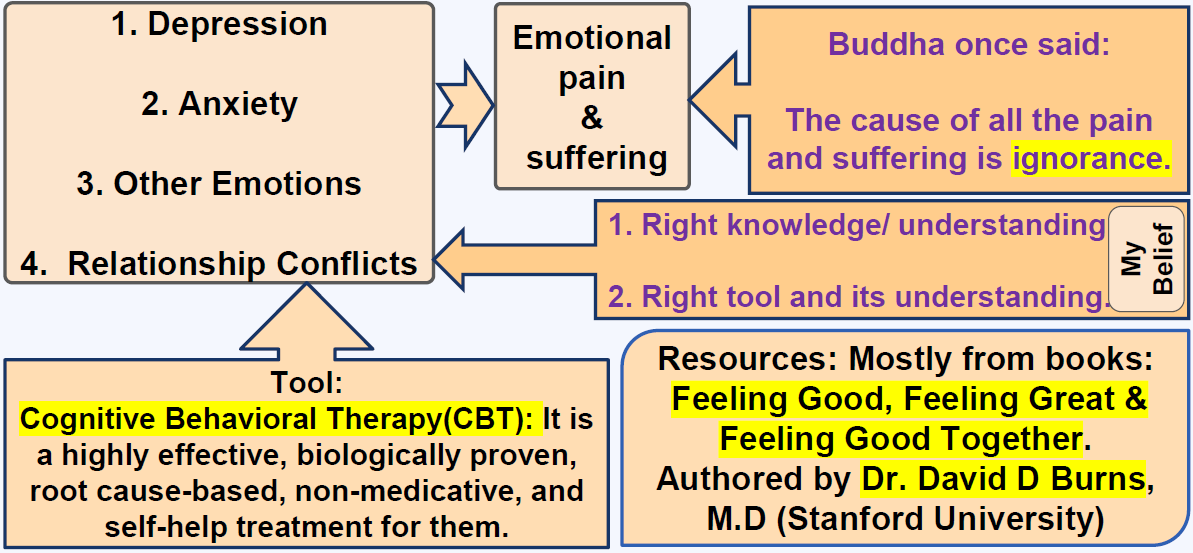
- We have seen that depression, anxiety, relationship conflict, other emotions such as Anger, Frustration, Guilt, Feeling-trapped, Embarrassment, Inferiority & Shyness are significant cause of our emotional pain and suffering, and that contribute to feeling us down.
- Buddha once said: The cause of all the pain and suffering is ignorance. That means right understanding/knowledge can alleviate us from these pain and suffering. My experience and belief also agrees that the right understanding/knowledge along with right tool can reduce these pain and suffering to a higher extent.
- Cognitive behavioral therapy (CBT) is a highly effective, biologically proven, root cause-based, non-medicative, and self-help treatment for them.
- Resources are mostly taken from the books named 'Feeling Good', 'Feeling Good Together' and 'Feeling Great' authored by Prof. (Dr.) David D. Burns.
- About Dr. David D. Burns: He is an American psychiatrist and adjunct professor emeritus in the Department of Psychiatry and Behavioral Sciences at the Stanford University School of Medicine. His recent book named 'Feeling Great' has gained huge popularity for the treatment of Depression, Anxiety and Relation Conflicts.
- The goal of this note is to provide you deeper understanding about depression, anxiety, and other emotions, and how to use CBT to address these issues. We will first understand CBT and its principles.
Cognitive Behavioral Therapy
(CBT)
- Cognition means Thought, Way of Thinking, Believe, Perception, or Interpretation.
- Cognitive behavioral therapy (CBT) is tool that help tune our cognition (Thought, Way of Thinking, Believe, Perception, or Interpretation). This, in turn, tunes our feelings, moods, emotions.
- Cognitive Behavioural Therapy is:
- A self-help, self-taught, and self-practiced approach,
- Non-medicative (no medication required),
- Biologically-proven,
- Focused on addressing root causes,
- Highly effective in the treatment of depression, anxiety, and any other forms of emotional distress.
Three Principles of Cognitive Behavioral
Therapy
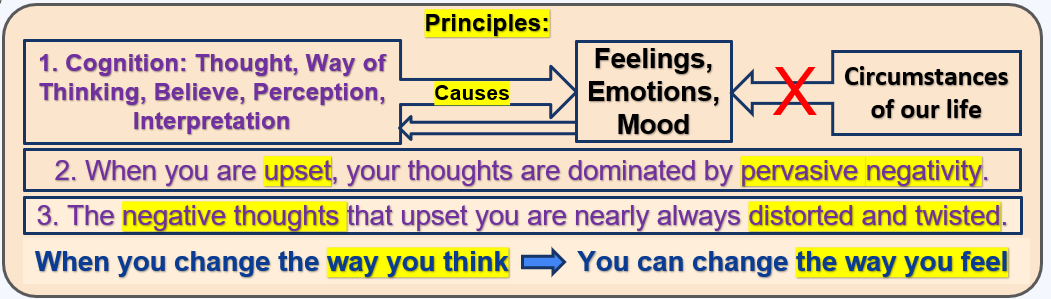
- 1st Principle: Cognition, Thought,
Way of Thinking, Believe, Perception, or Interpretation are the major
cause of our bad/good emotions, feelings or moods.
However, sometimes our feeling/moods/emotions creates certain kinds thoughts. For example, when you are physically ill, you may get a different kinds of emotions, and that generates a very different kinds of thoughts you generally experience when you are not feeling well. In contrast, circumstance of our life are not the main cause of our good/bad feelings, on which we generally belief. - 2nd Principle: When you are upset, your thoughts are dominated by pervasive negativity negative thoughts.
- 3rd Principle: The negative thoughts that upset you are nearly always distorted and twisted. (There exits about 12 thoughts distortion.)
-
The core of message of CBT is that when you change the way you think, You can change the way you feel. - Various quotes also support the core message, such as,
- Epictetus said in about 2000 years ago: People are disturbed “not by things, but by the views we take of them.”
- Shakespeare: “For there is nothing either good or bad, but thinking makes it so.”
- Lori Deschene on Buddha’s statement: Thoughts fuel emotions. If you don’t like what you’re feeling, step back and examine what you’re thinking.”
Three Principles of Cognitive Behavioral
Therapy
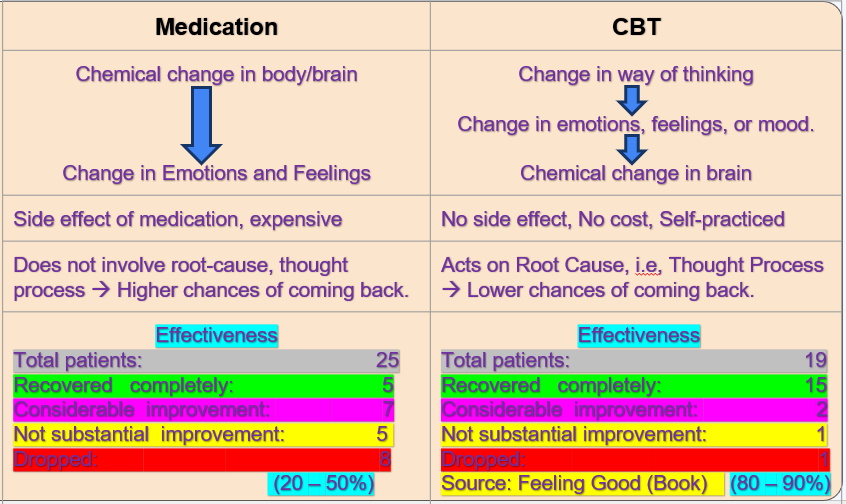
Figure: Effectiveness of Medication and CBT. Quantative values are taken from Book 'Feeling Good' Authored by Dr. David D Burns.
The book "Feeling Good" provides a table comparing the effectiveness of medication and CBT. In this table, 25 patients were selected for medication and 19 for CBT. Out of 25 patients selected for medication, 5 recovered completely, 7 had considerable improvement, 5 had no substantial improvement, and 8 dropped out. On the other hand, out of 19 patients selected for CBT, 15 recovered completely, 2 had considerable improvement, 1 had substantial improvement, and 1 dropped out. Overall, we can see about a 20-50% recovery rate with medication and an 80-90% recovery rate with CBT. In summary, CBT is more effective than medication for recovery from depression and anxiety.
Defining Feelings and Emotions/Moods
Feelings and moods are mental states associated with our behavioral and social responses. Emotions are very similar to Feelings and moods, However, from a biological perspective, they are defined as energy in motion and energy in motivation.
We can remember all the negative feeling/moods using the word "PH(F)ANTASIZED." The names of these feeling/moods start with the letters involved in this word. For example. Phantasized (PH) is a mental image of something that is not perceived as real. Fantasized (F) a daydream, an imagined unreality. Coincidently the Word Phanatizsed is a mental state that we also feel during the some of feeling moods shown here. Panic Anxiety and Nervousness can be clubbed together as they have similar meaning, similarly depression and hopelessness can be clubbed together they also also hve similar meaning. So let us define and understand each feeling/mood one-by-one.
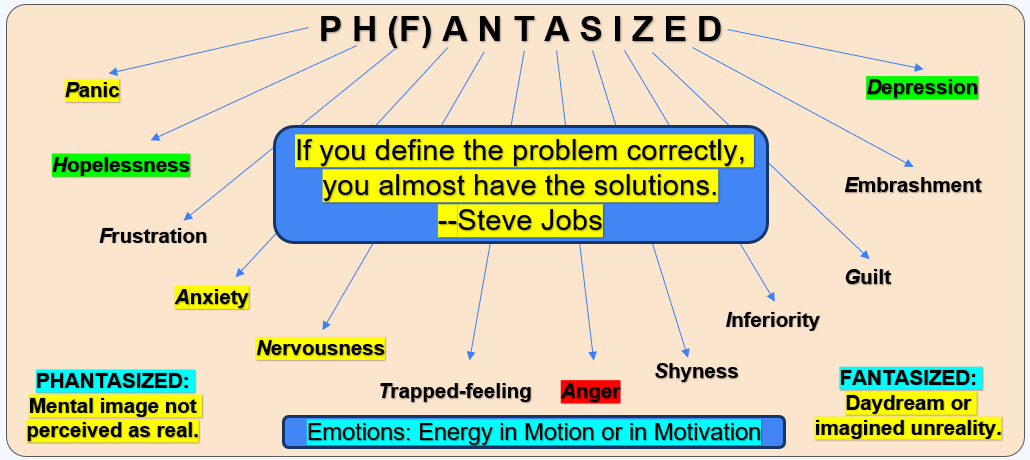
Figure: Effectiveness of Medication and CBT. Quantative values are taken from Book 'Feeling Good' Authored by Dr. David D Burns.
- 1. Depression or Hopelessness: You tell yourself that
- you are a failure or worthless.
- you have lost something important to your sense of self-esteem.
- there is something wrong with your brain.
- your situation is never going to change (Hopelessness).
- your problem will never be solved and suffering will go on forever(Hopelessness)
- 2. Anxiety or Nervousness or Panic: You tell yourself that
- you are in danger, and something terrible is about to happen (Anxiety).
- you are about to die, suffocate, lose control, or go crazy (Panic).
- something bad is happening/might happen/about to happen(Nervousness).
- 3. Anger: You tell yourself that
- other people are self-centered and treating you unfairly.
- other people are intentionally taking advantage of you.
- 4. Frustration: You tell yourself that
- the other people or events should be the way you expected them to be.
- 5. Guilt: You tell yourself that
- you are a bad person, or
- you have violated your own value system.
- 6. Embarrassment: You tell yourself that
- you looked like an idiot in front of other people.
- 7. Inferiority: You tell yourself that
- you are not as good as other people, or
- you are not as good as you should be.
- 8. Trapped-feeling: You tell yourself that
- you have to give in to demands of friends, families, or spouse.
- 9. Shyness: You tell yourself that
- other people will see how nervous and insecure you feel, and look down on you.
--Main difference in depression and anxiety: Both of them are two prominent mental health issues in the world, and often occur together. If you are suffering from depression, you are likely also suffering from anxiety. However, if you are suffering from anxiety, you may or may not be suffering from depression.
Healthy Emotions/Feelings and Their
Quantification
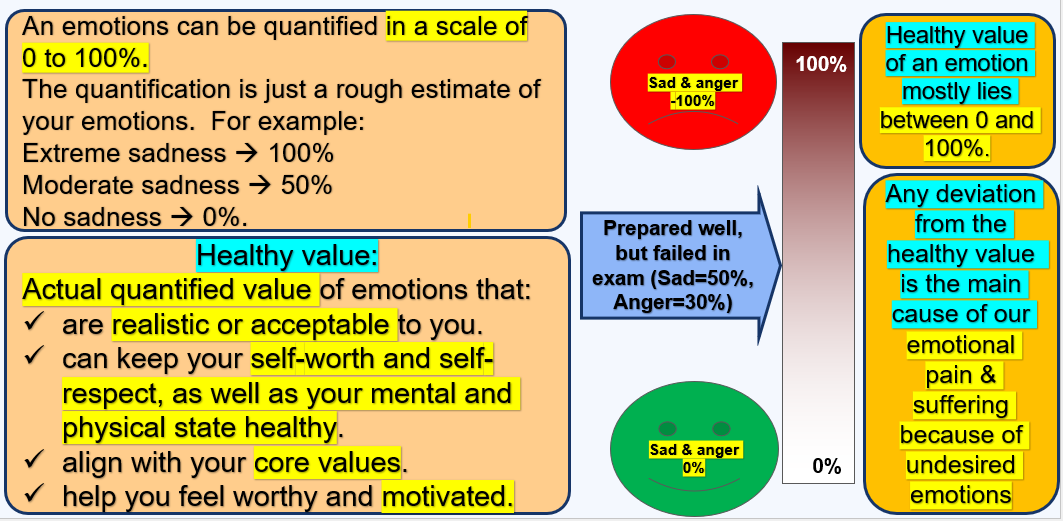
Figure: Quantification of Emotions/Feelings and Their Healthy Values.
The healthy value of an emotion typically lies between 0% and 100%. Extreme emotions, such as 0% or 100%, are rare, and such quantifications are also good for you and your emotional health. Let us understand it using the following example:
Suppose you prepared well for an examination and performed well, but you failed. There might have been some mistakes in the evaluation process. You might feel 50% sadness because you failed despite your best effort and 30% anger because you suspect unfairness in the evaluation process. These are estimates of your healthy emotions.
However, if you exhibit extreme sadness or anger (100%), you may become stuck in your emotions and unable to take further action for re-evaluation, or you might take extreme actions, which could also be unfair.
On the other hand, if you do not show any sadness or anger (0%), it could indicate that you don’t care about yourself, your time, energy, and effort put into the examination, or you might not be conscious of fairness in the evaluation process. In this case, you won’t be motivated to seek re-evaluation or to work hard again for a reexamination if you genuinely failed.
Both extreme cases are not beneficial and are likely to create other emotions such as depression, anxiety, hopelessness, loneliness, inadequacy, and guilt. In short, any deviation from the healthy value is the main cause of our emotional pain and suffering due to undesired emotions. That is why it is very important to estimate the healthy value of your emotions.
Emotions: Energy in Motion or in Motivation
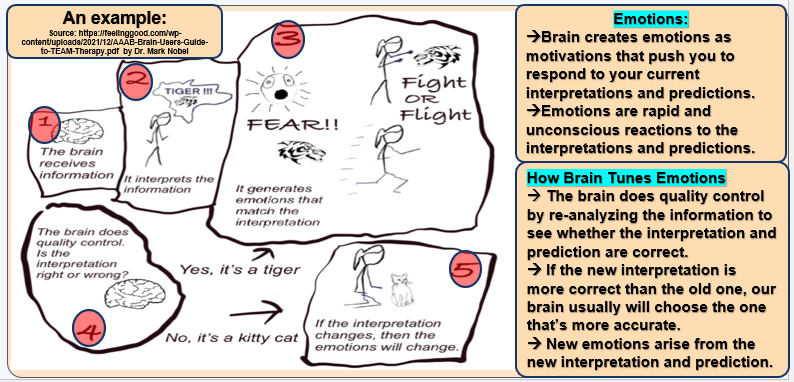
Figure: Quantification of Emotions/Feelings and Their Healthy Values. Information taken from "A Brain User’s Guide to TEAM Therapy" written by Dr. Mark Noble, a Professor of Genetics and Neuroscience at the University of Rochester Medical Center.
- Step 1: The brain receives information from inside the body and from the outside world. For example, you suddenly hear loud and unexpected sound and saw a cat suddenly jumping in a fear.
- Step 2: The brain interprets this information to make sense of what’s happening and to predict what’s going to happen next or what you need to do. Making predictions is one of the most important brain functions. Interpreting information and making predictions occurs quickly and takes place almost entirely at an unconscious level we don’t even notice. For example, your brain may be interpreting the unexpected sound and predicting that the sound is of a tiger, that is why the cat was jumping in fear.
- Step 3: The brain next creates emotions as motivations that push you to respond so that what you do is aligned with your interpretations and predictions. This happens quickly and without your conscious awareness. Emotions are not conclusions you reach; instead, they are rapid and unconscious reactions to your interpretations and predictions. Whatever emotions you’re experiencing, the key to understanding them is to identify the interpretations that cause them. For example, after predicting that there is a sound of tiger, your brain creates emotions as a motivation to either fight or flight quickly without conscious effort.
- Step 4: It’s possible that the first interpretations and predictions you make are wrong, so your brain also performs some quality control. In this step, your brain re-analyzes information in case the interpretations and predictions are needed to be changed. If one interpretation is more correct than another one, your brain usually selects the one that’s more accurate. After all, you’re more likely to survive if your predictions are based on correct interpretations rather than incorrect ones. For example, after performing the quality control by brain, you may find that the sound is generated artificially by a music system.
- Step 5: If the original interpretations and predictions are wrong, then your brain also may have generated the wrong emotions. By performing the quality control, your brain automatically generates different emotions to match your new interpretations and predictions. For example, after predicting that there is no tiger, our brain automatically and unconsciously generates different kinds of emotions, and you see that the situation in a completely different perspective.
What is Negative Thought?
A negative thought is a thought that upsets you and makes you feel down.
The properties of the negative thoughts are:
- Intensity of feelings/emotions related to the thought is far from their healthy values.
- Your strong belief in it is the main cause behind your emotional pain and suffering.
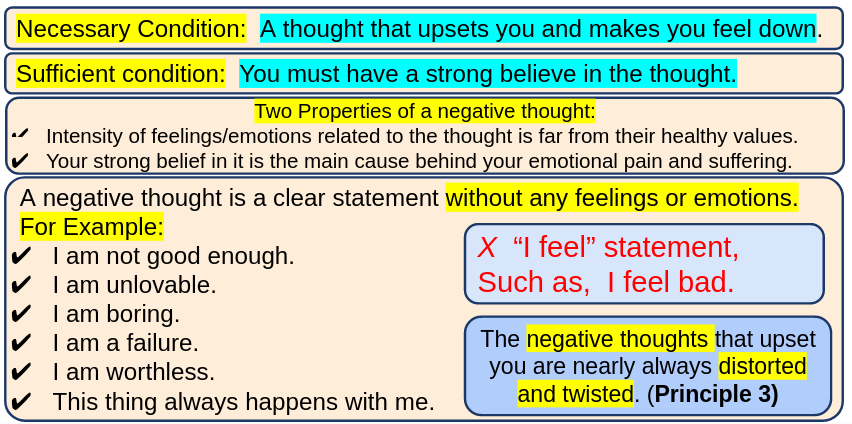
Figure: The necessary and a sufficient condition of a negative thought, and examples of negative thoughts.
- I am not good enough.
- I am unlovable.
- I am boring.
- I am a failure.
- I am worthless.
- This thing always happens with me.
We have seen in third Principle of CBT, that a negative thought that upsets you are nearly always distorted and twisted. Now let us define "distorted thoughts" or "thought distortions".
Understanding of Thought Distortions
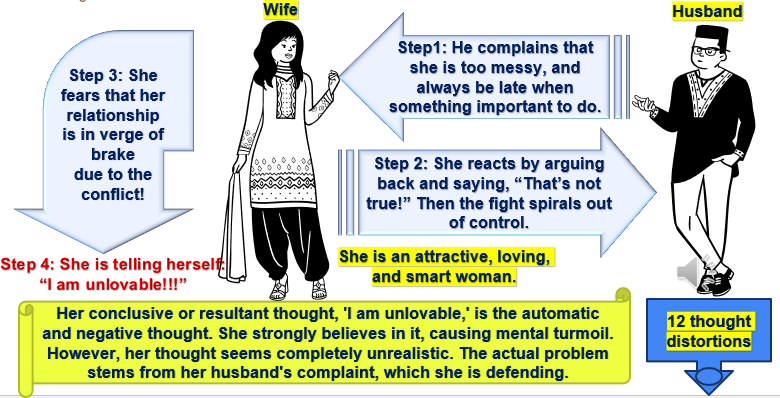
Figure: Understanding of Thought Distortions.
- In Step 1: Husband complains to his wife that she is too messy, and always be late when something important to do.
- In Step 2: She reacts by arguing back and saying, "That’s not true!". Then the fight spirals out of control.
- In Step 3: She Fears that her relationship is in verge of brake due to the conflict.
- In Step 4: She reaches at a conclusion in her mind that "I am unlovable", that is why he is complaining.
- But the fact is that she is an very attractive, loving, and smart woman.
- Her conclusive or resultant thought, 'I am unlovable,' is the automatic and negative thought, in which she has a strong belief. This belief cause her mental turmoil. However, this thought seems completely unrealistic.
- The actual problem stems from her husband's complaint, which she is defending.
- So let us see 12 thought distortions that we generally find in negative thoughts, and examine how many of them belong in her negative thought.
Understanding of Thought Distortions
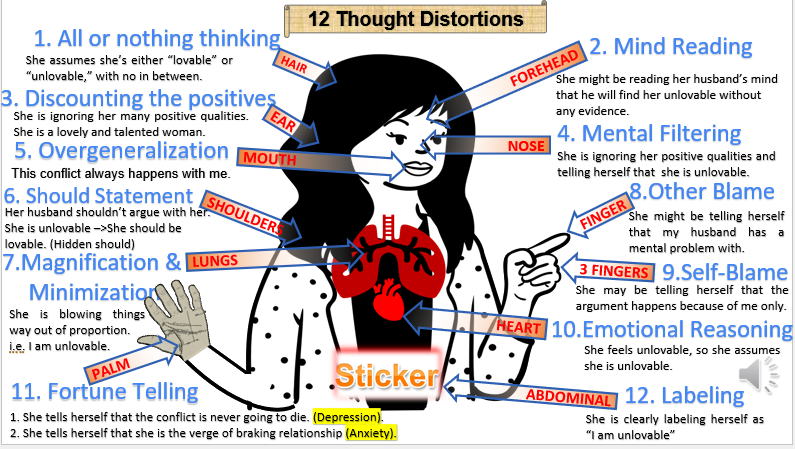
Figure: 12 Thought Distortions.
- 1. All-or-Nothing Thinking: I have
associated it with our HAIR , which can be black, white, or a
combination of both.
In this distortion, you think about yourself or the world in black-or-white, all-or-nothing categories. Shades of gray do not exist. When you fail, you tell yourself that you’re a complete failure. - For the example discussed here: She sees herself as either "lovable" or "unlovable," with no in-between.
- 2. Mind Reading: I have associated it
with our FOREHEAD , which can be the outer layer of
our brain that involves in reading minds.
In this distortion, you assume that you know what other people are thinking and feeling without any evidence. If you are shy, you may tell yourself that people will judge you if they find out how insecure you feel. - For the example discussed here: She might be reading her husband’s mind that he would be finding her unlovable. However, there does not exist any evidence behind the mind reading.
- 3. Discounting the Positives: I have
associated it with our EAR , which
sometimes only wants to hear things you are willing to accept
and rejects others.
In this case, you tell yourself that certain positive facts don’t count. When someone compliments you, you tell yourself that they’re only saying that to make you feel good. - For the example discussed here: She is ignoring her many positive qualities. She is a lovely and talented woman.
- 4. Mental Filtering: I have associated it
with the NOSE , which detects the quality
of air and shows willingness to accept good quality of
air. This quality is very similar to a brain function where
it enables you to focus on something negatives and filter out
all the positives.
In this case you become obsessed about some shortcoming and ignore your positive qualities. This is like a drop of ink that discolors the entire beaker of water. - For the example discussed here: She is completely ignoring her many positive qualities that she is a lovely and talented woman.
- 5. Overgeneralization: I have
associated it with the MOUTH , which
involves expressing overgeneralized thoughts.
In this case, you think that a negative event always happens to you or is a never-ending pattern. If something bad happens to you twice or thrice, you tell yourself that it always happens to you. - For the example discussed here: She might be telling that such conflict always happens with her. However, in reality, similar conflicts are very common in husband and wife.
- 6. Should Statement: I have
associated it with SHOULDER , which is very
similar to Should in terms of accepting taking the
responsibility for something.
In this case you make yourself miserable with should, musts, or ought to statement. There are Self-directed, Other-directed, and World-directed shoulds.
-Self-directed shoulds cause feelings of guilt, shame, depression, and worthlessness.
-Other directed shoulds trigger feelings of anger and frustration toward others.
-World-directed shoulds cause feelings of anger and frustration toward the world.
There also exists some hidden shoulds, for example, if you are telling yourself I am looser, you might be telling yourself that I should not be a looser. - For the example discussed here: She might be telling herself that her husband shouldn’t argue with her. This is example of other-directed should. She might be telling that I should be lovable. This is an example of self-directed should. She is telling herself that she is unlovable, which is indicating she should be lovable. This is an example of a hidden should statement.
- 7. Magnification and Minimization: I
have associated it with LUNGS that help us
breathe by maximizing and minimizing the exchange of gases, a
very similar function that our brain plays with our thoughts.
In this case you blow things out of proportion or shrink their importance inappropriately. This is also called the “binocular trick” because things look much bigger or much smaller depending on what end of the binoculars you look through. In the case of procrastination, you often focus on everything you’ve postponed, convincing yourself that it will be extremely overwhelming. This is the case of magnification. On the other hand you may downplay today's efforts as insignificant, leading you to delay tasks further, which is an example of minimization. - For the example discussed here: She is blowing things way out of proportion by telling herself as I am unlovable.
- 8 & 9. Other Blame and Self blame: I
have associated them with our FINGERS fingers, which
reminds us a famous saying: when you point one finger at others for
their faults, there are always three fingers pointing back at you,
reminding you to see your own faults too before pointing out faults in
others.
In the case of Other blame, You use all your energy finding fault with others. Such blame is very common in relationship conflict where you tell yourself that the other person is to blame for the problems in our relationship, so you feel like an innocent victim and overlook your own role in the problem. - For the example discussed here: She might be telling herself that her husband has a mental problem, and therefore, he needs to be blamed for the conflict. She perceives herself as not playing any role in the conflict, it means that she is not contributing anything for the conflict. Consequently, she feels that she doesn’t have to change herself.
- For the example discussed here: She might be telling herself that the conflict happens because she is unlovable. In this case, she is placing complete blame on herself for the conflict.
- 10. Emotional Reasoning: I have associated it with the HEART, as it is closely tied to our good or bad feelings & emotions.
In emotional reasoning, you reason from how you feel. This can be very misleading because your feelings result entirely from your thoughts and not from external reality. You tell yourself, “I feel like a loser, so I must really be one.” Or “I feel hopeless, so I must be hopeless. - For the example discussed here: She may be feeling unlovable that is why she is calling herself she is unlovable.
- 11. Fortune telling: I have
associated it with PALM because palm
reading or Palmistry is a pseudoscientific practice of
fortune-telling. Such practice is found all over the world,
with numerous cultural variations.
In this case, you make negative or positive predictions about the future. If you’re depressed, you tell yourself that your problems can never be solved and that you’ll be depressed forever. - For the example discussed here: If she is suffering from depression. She might be telling herself that the conflict is never going to die. In the case of anxiety, she may be telling herself that she is the verge of breaking her relationship, and she is predicting that one day it will definitely break.
- 12. Labeling: I have associated it with
our ABDOMINAL having a sticker with negative
thoughts/quotes.
In this case you label yourself or others where you see your yourself or someone else as totally defective or superior.
In the case of Self Blame, You use all your energy finding fault with yourself. You criticize yourself mercilessly for every error and shortcoming you are committing, instead of using your energy to find creative solutions to your problems.
- For the example discussed here: She is clearly labeling herself as “I am unlovable”.
Short form of Thoughts Distortions and its
Identification
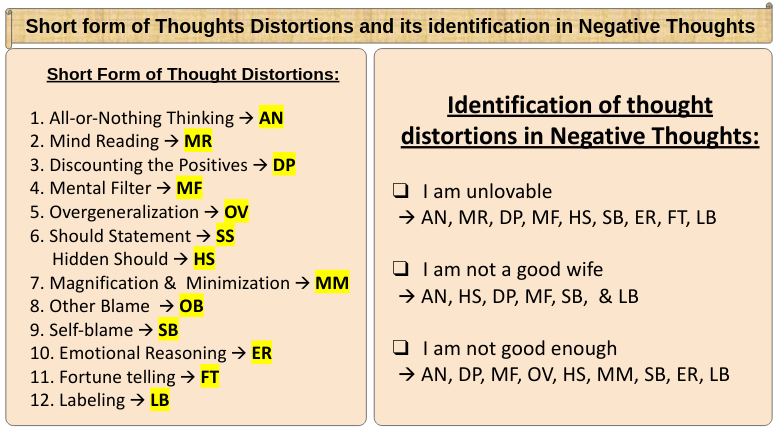
Figure: Short form of Thoughts Distortions and its identification in Negative Thoughts.
Daily Mood Journal and How to Write it
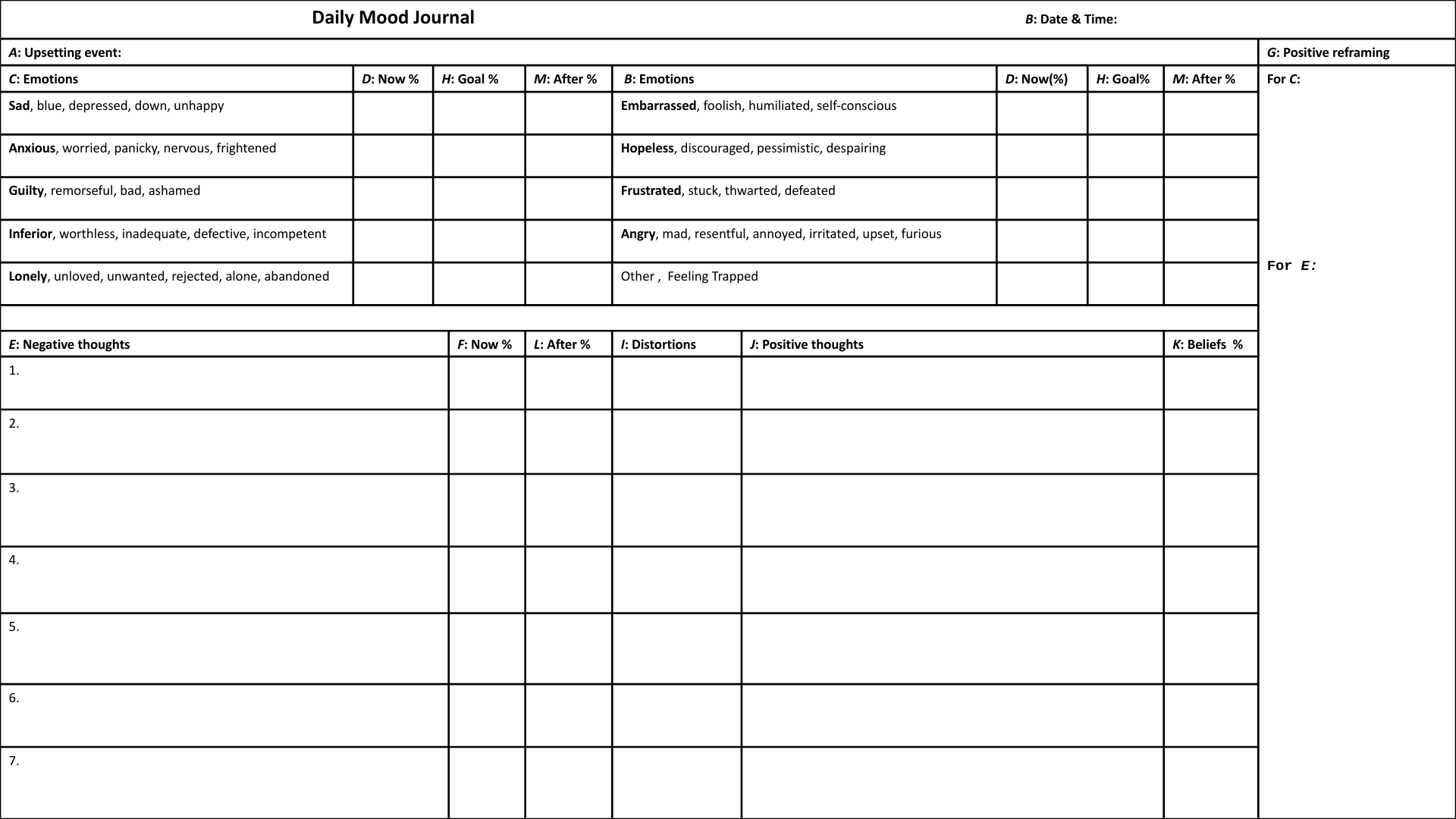
Figure: Daily Mood Journal (reformatted from the original Daily Mood Journal created by Dr. David D. Burns). It involves steps A to M, which should be followed when writing.
Write about an upsetting event or incident from which the negative or automatic thoughts emerge. Address each event/incident individually -- do not include multiple events in the same journal entry. Note that most of your emotional distress is typically tied to the specific event.
For the example considered here: Upsetting event is "Argument with husband".
Write exact date and time of the event.
Identify the emotions and quantify them as per their actual intensities (%Now).
For the example considered here, She would be feeling:
- Sad + Unhappy 🡪 80%
- Anxious + Frightened 🡪 90%
- Guilt + Bad 🡪 60%
- Inferior + Defective 🡪 80%
- Lonely + Rejected + alone 🡪 90%
- Humiliated + Self-conscious 🡪 80%
- Hopeless + Despairing 🡪 70%
- Frustrated + Stuck 🡪 60%
- Angry + Upset 🡪 75%
- Feeling trapped 🡪 80%
Identify the negative thoughts related to the upsetting event along with your believe in the thought (%Now).
Do not write feeling and emotions as they are covered in Step C.
For the example considered here, some of her negative thoughts and her current believes would be:
- I am unlovable 🡪 90%
- No one cares about me. 🡪 80%
- I am worthless. 🡪 90%
- I am stuck in a bad relationship 🡪 90%
- I should not marry him. 🡪 80%
- I am a bad wife. 🡪 90%
- Q1: What are some benefits, or advantages, of this negative thought or feeling? How might it be helping you?
- Q2: What does this negative thought or feeling show about you and your core values that’s positive and awesome?
- Anxiety 🡪 It motivates her to do the hard work to save her relationship. It makes her vigilant about trying to protect her relationship. She care a lot about her relationship.
- Sad/Depression 🡪 She is feeling a loss of love and care that she used to get from her husband. It shows that she is being honest and realistic about herself and how she is feeling.
- I am a bad wife 🡪 It shows she has high standard and want to do the best for her relationship.
- Noone cares about me 🡪 It motivates her for a) self-love or self-care, and 2) becoming independent and financially stable. She respects and loves herself.
- I am stuck in a bad relationship 🡪 She has a sense of what a good relationship should be. It motivates her for finding a way to make relationship better.
- I am unlovable 🡪 he is finding herself responsible for the argument. It shows that she cares a lot about her husband/relationship.
- I am worthless/defective 🡪 It motivate her to work hard to learn things that I can help improve her relations. She has a sense of her weaknesses.
- Feeling Trapped 🡪 It makes her vigilant about choosing a relationship that ultimately protect her from suffering.
- Alone 🡪 She cares a lot about relationship with her husband/other that she doesn’t want to be a burden on him/others.
- Anger 🡪 It shows that she has a sense of justice and fairness in a relationship. It protect herself by facing the very fact of life that the life can sometimes be pretty harsh and unfair.
For the example considered here, She would be estimating the following goals for her emotions/feelings:
- Sad + Unhappy 🡪 20%
- Anxious + Frightened 🡪 30%
- Guilt + Bad 🡪 30%
- Inferior + Defective 🡪 20%
- Lonely + Rejected + alone 🡪 30%
- Humiliated + Self-conscious 🡪 20%
- Hopeless + Despairing 🡪 10%
- Frustrated + Stuck 🡪 20%
- Angry + Upset 🡪 15%
- Feeling trapped 🡪 0%
For the example considered here, some of her negative thoughts and her current believes would be:
- I am unlovable 🡪 AN, HS, MF, DP, ER, SB, MR, LB
- No one cares about me. 🡪 AN, SS, ER, OV, ER, FT
- I am worthless. 🡪 AN, MF, ER, MM, SB
- I am stuck in a bad relationship 🡪 HS, FT, ER, SB, OB, DP
- I should not marry him. 🡪 SS, FT, ER, MF, DP
- I am a bad wife. 🡪 LB, AN, HS, SB, OB, MM, OV
- You must have a thought that upsets you and makes you feel down (necessary condition), and
- You must have a strong belief in the thought (sufficient condition).
- (necessary condition), You have a a thought (or identify a thought) that must crush the respective negative thought, or drastically reduce your belief in the negative thought (necessary condition)) and
- You must have a strong belief in the thougth for the chosen negative thought (sufficient condition). Fill the value of your strong belief in (Step K).
For the example considered here, positive thoughts for her negative thoughts would be:
- Negative thought: I am unlovable
🡪
Positive thought: Sometimes I feel unlovable, especially during arguments, but not always. (Straightforward techniques). - Negative thought: No one cares about
me. 🡪
Positive thought: It’s not entirely true — many of my friends and relatives care about me a lot. (Examine the evidence). - Negative thought: I am
worthless. 🡪
Positive thought: No, taking this event into account has nothing to do with proving that I am worthless. (Examine the evidence). - Negative thought: I am stuck in a
bad relationship 🡪
Positive thought: To some extent, I feel stuck in a difficult relationship. But in general, all relationships experience some conflict at some point. There's no guarantee that if I were in another relationship, such conflicts wouldn't happen there as well.(Socratic Method & Thinking in terms of Shades of Gray) - Negative thought:I should not marry
him. 🡪
Positive thought: It would be nice if I were married to a different person, but there's still a high chance that similar conflicts would happen with them too.(Semantic Method & Thinking in terms of Shades of Gray) - Negative thought:I am a bad
wife. 🡪
Positive thought: This single incident does not prove that I am a bad wife. Sometimes bad behavior happens, but that doesn't mean a bad person exists. If I try to define what a "bad person" is, I can't. In fact, surveys suggest that I'm not a bad person at all — they actually say I'm a nice person. (Let's define terms, and Survey technique)
- Evaluate and write your current believe in each negative thought in % After column of Step L.
- Estimate and write your current intensities of emotions in % After column of Step M.
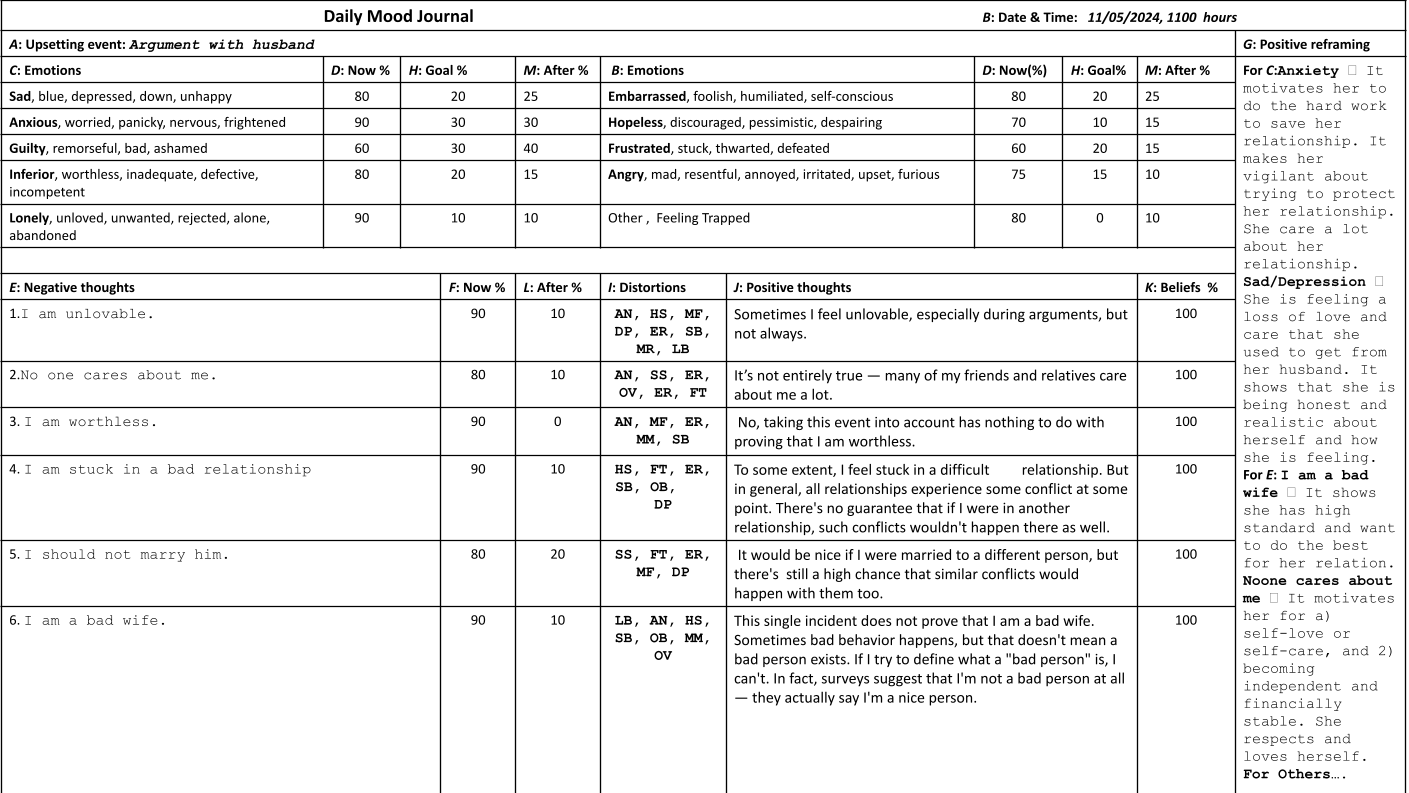
Figure: Daily Mood Journal for the Women, who is consider here in the example.
15 Frequently Used Techniques to Write Positive
Thoughts
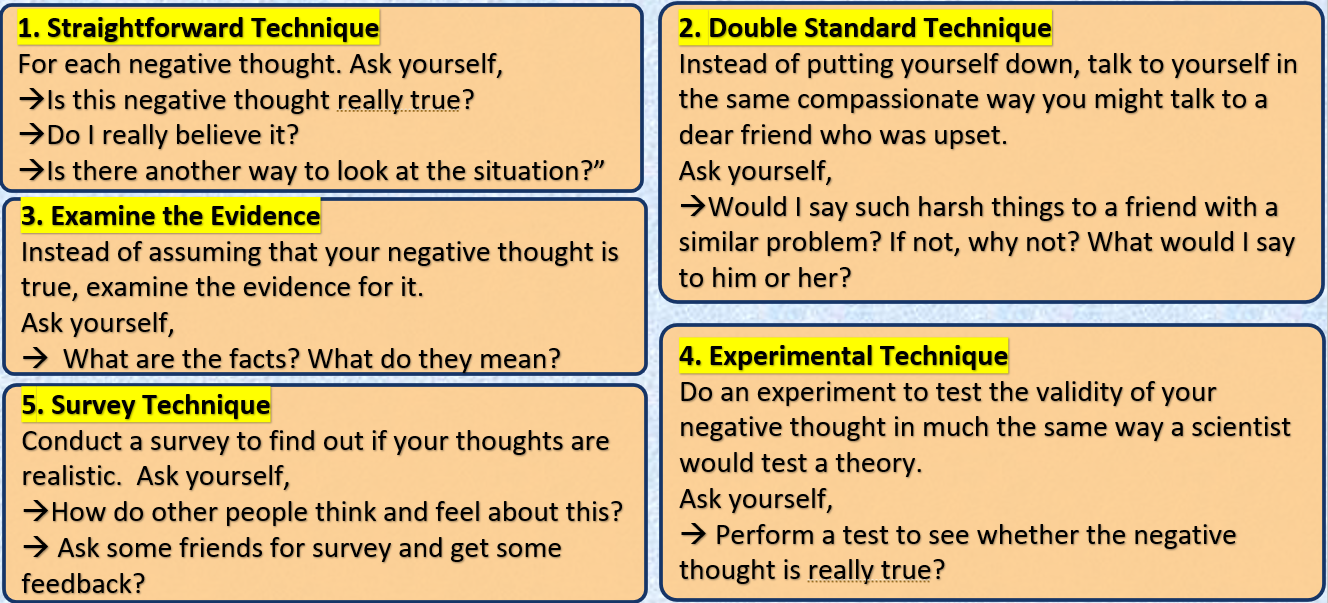
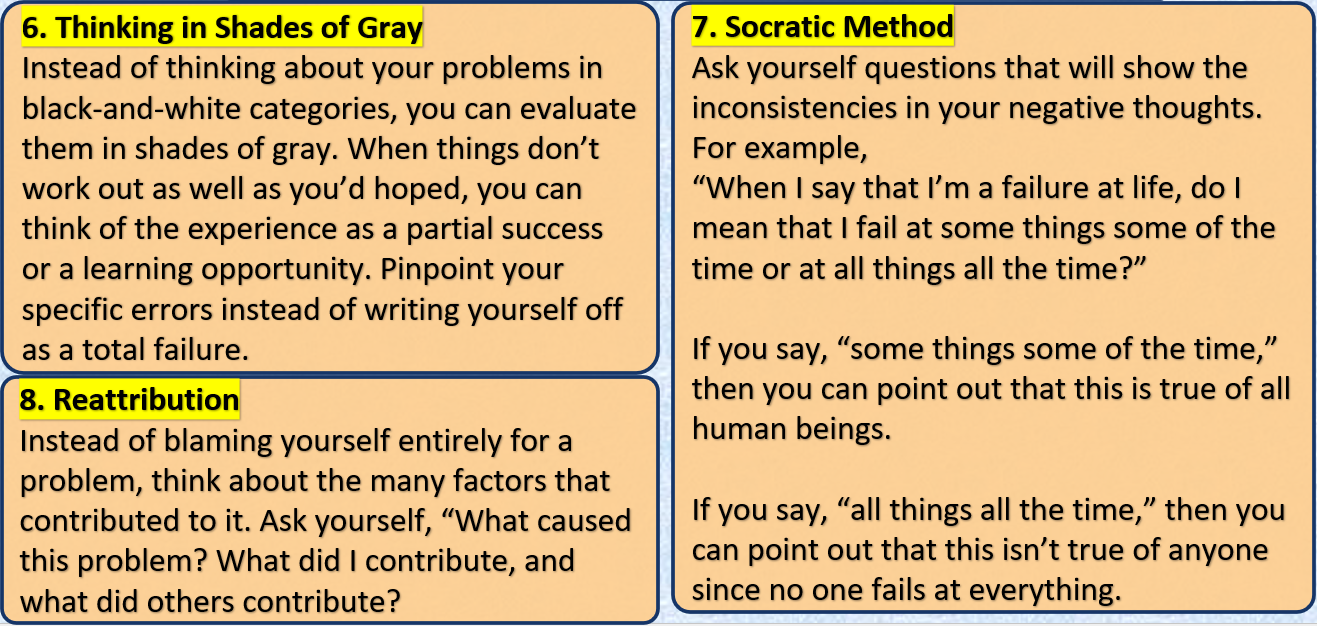
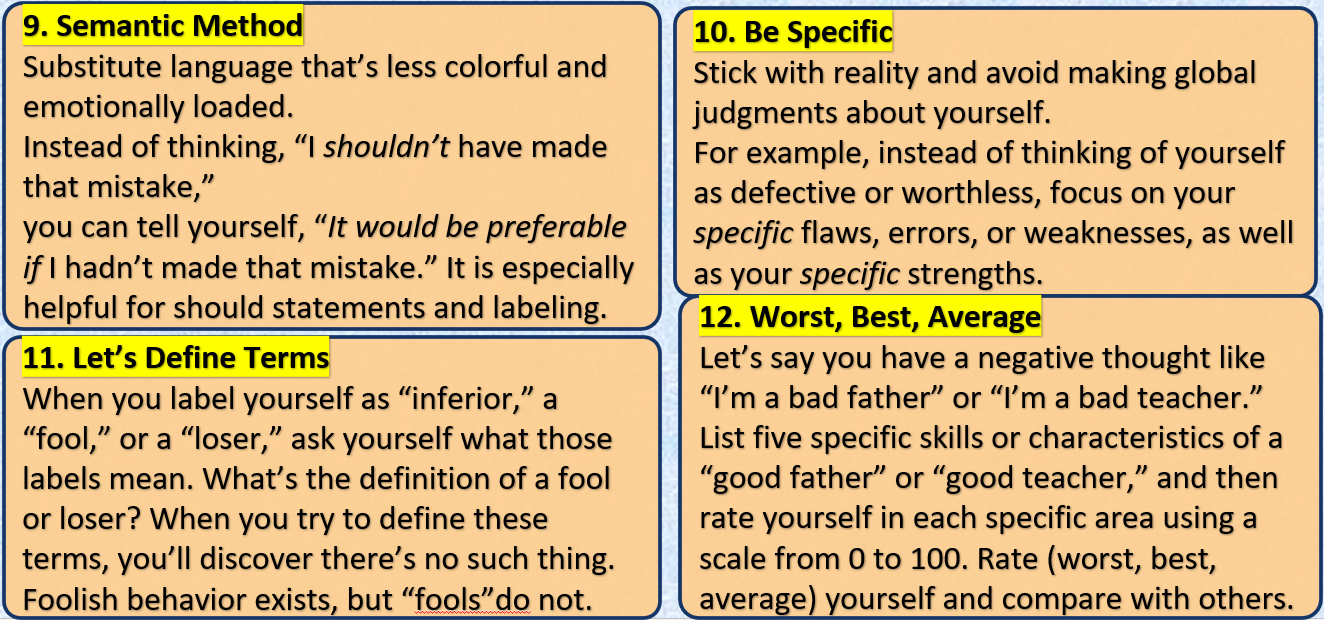
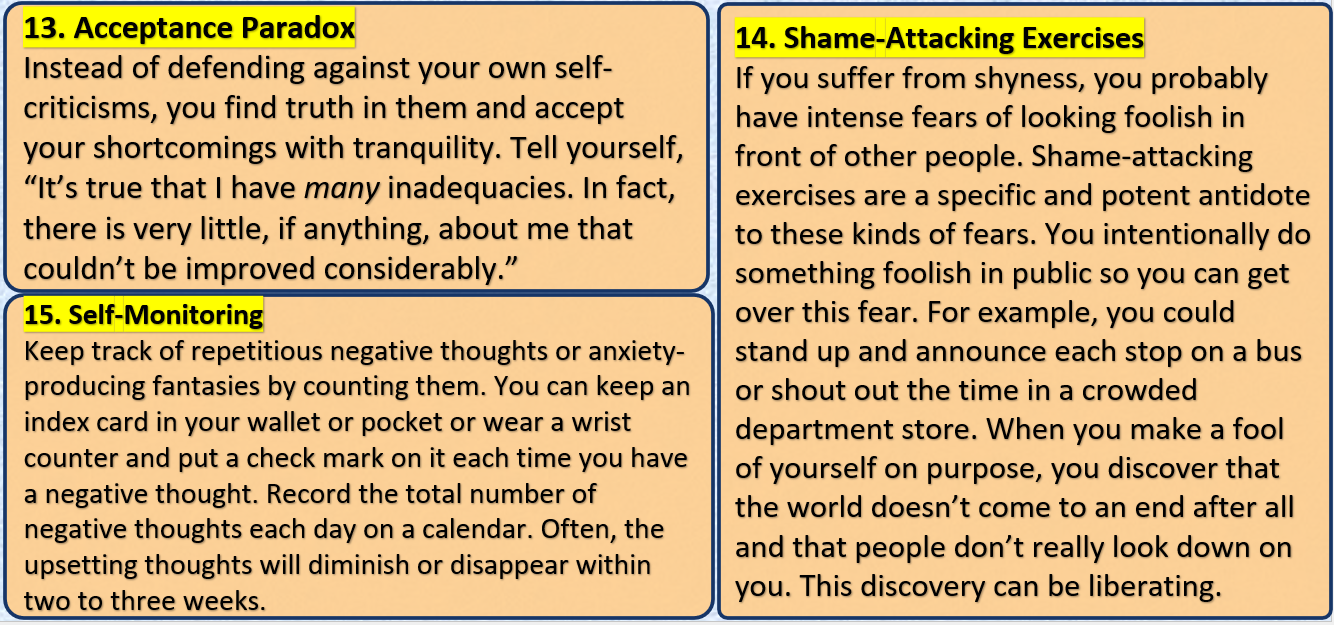
Figure: 15 Frequently Used Techniques to Write Positive Thoughts (Info taken from Feeling Good/Feeling Great Books of Dr. David D. Burns).
Daily Mood Journal (Template)